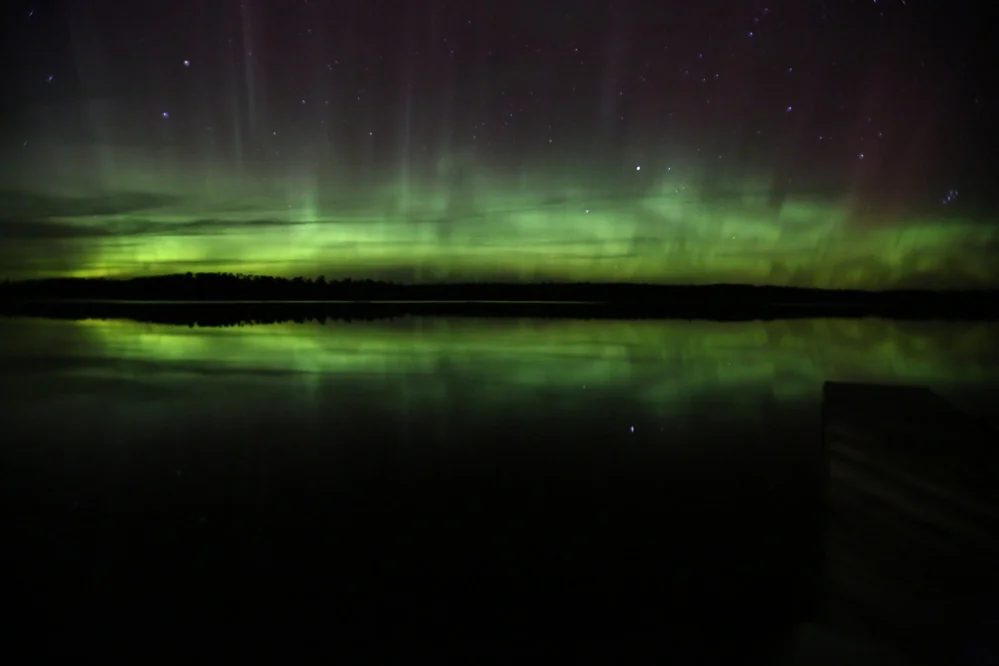
You don't have to fly to Alaska, Iceland, or the Yukon to stand under the northern lights. On the right night — dark, clear, and geomagnetically active — the aurora reaches into the northern Lower 48, and the band that catches it best runs along the Lake Superior shore and the northern plains: Michigan's Upper Peninsula, northern Minnesota, and North Dakota. We're in the current solar-maximum window, when aurora activity stays elevated into 2027, and this loop chases it across some of the darkest, farthest-north country you can reach without a passport. Read it as odds-stacking, not a booking — the lights are never guaranteed at these latitudes. Here's where to point the car, when to go, and how to catch a show.
Chase the aurora across the northern Lower 48 — no passport, no flight to Alaska.
What this aurora road trip actually is
This isn't a linear drive with a finish line — it's a chase. You base yourself in the darkest, farthest-north corners of the Lower 48 and move toward whatever patch of sky is dark, clear, and active that night. The geography is the Lake Superior shoreline and the northern plains: Michigan's Upper Peninsula reaches nearly 48° north, and northern Minnesota and North Dakota sit against the Canadian border — vast dark country with an open view to the north, exactly where the aurora appears.
Timing is the other half. The sun runs on an 11-year cycle, and we're near solar maximum, when storms are more frequent and aurora activity stays elevated into 2027. That doesn't mean the lights are on every night — but your odds on any clear, dark night are better now than they'll be for years. You're improving your chances, not buying a guaranteed show.
Lower-48 aurora & dark-sky map
The best viewing spots at a glance — dark-sky country across the northern Lower 48.
When to go
The real answer is any dark, clear night when a geomagnetic storm is firing — and those can't be scheduled. But some windows tilt the odds your way.
Around the equinoxes — late February through March, and September into October — geomagnetic activity tends to run higher, with a workable balance of long nights and tolerable cold. Winter gives you the longest, darkest nights but bitter cold, with hours of standing still outside. Summer is weakest: nights are short and never fully dark near the solstice. Whenever you go, aim for the days around a new moon — a bright moon washes out a faint aurora just like city light does.
How to actually catch the aurora
Catching the northern lights in the Lower 48 means stacking five conditions on the same night. Miss one and the show is off — patience and flexibility beat any single destination.
1. Darkness
Light pollution is the killer: an aurora obvious from a dark-sky park is invisible from a lit parking lot. Get well away from town glow and plan your nights around the new moon.
2. A clear sky
Clouds beat everything, no matter how strong the storm. Watch the cloud-cover forecast as closely as the aurora forecast, and be ready to drive toward a hole in the clouds — the main reason to stay mobile.
3. Geomagnetic activity — check the Kp index
The aurora needs a solar disturbance to reach our latitudes, measured by the Kp index (0–9). In the northern Lower 48 you generally want Kp around 5 or higher — higher means brighter and farther south. Check the NOAA Space Weather Prediction Center forecast and an aurora app, hours to a day or two ahead.
4. A low, unobstructed view to the north
From here the aurora usually sits low on the northern horizon, so you need a clear line of sight that way — an open lakeshore, prairie, or high overlook. Trees or a skyline to the north will hide a modest display, which is why a north-facing Great Lakes beach is ideal.
5. Patience and late hours
Activity often peaks around local midnight and before dawn, and storms come in waves — a quiet sky can erupt an hour later. Dress far warmer than you think, let your eyes adjust, and wait. Even a perfect setup sometimes delivers nothing — treat every clear dark night as a bonus. (Our planning guide and its drive-time caps help here.)
The aurora loop, region by region
These are the best dark, north-facing bases in the Lower 48, arranged as a loose loop west across the UP into Minnesota and North Dakota. Pick the subset the weather and Kp forecast favor — this is a chase, not a fixed schedule. All distances are planning estimates.
Copper Harbor, Brockway Mountain & the Keweenaw Dark Sky Park
The Keweenaw reaches farther into Lake Superior than anywhere in Michigan, and its tip is one of the best aurora spots in the Lower 48 — remote, dark, the sky wide open over the water. Base near Copper Harbor and drive up Brockway Mountain for the panoramic north view.
Presque Isle Park & the Marquette shoreline
Marquette is the UP's largest town and the practical hub, yet it still has dark, north-facing shoreline minutes away. Presque Isle Park sits on a point with open Lake Superior views — the pick if you want a bed and dinner within reach of a dark horizon.
Pictured Rocks & the Grand Marais shoreline
The Pictured Rocks shoreline and the harbor town of Grand Marais (Michigan, not the Minnesota town) give you miles of dark, undeveloped Lake Superior beach facing due north. It's quiet and remote — the appeal and the catch — so pack for a long, cold wait by the water.
Headlands International Dark Sky Park
Headlands, just west of Mackinaw City, was one of the country's first International Dark Sky Parks — dark, protected, and open to the north over the water. It's the easternmost, most accessible anchor of the loop, near the Mackinac Bridge, and strong storms show well here.
Voyageurs National Park
Voyageurs, in far northern Minnesota, is a certified International Dark Sky Park right on the border — about as far north and dark as the Lower 48 gets. It's a park of interconnected lakes, so the best viewing is often beside the water with a wide northern horizon. Base near International Falls.
Boundary Waters & the Cook County North Shore
The Cook County North Shore and the edge of the Boundary Waters, anchored by Grand Marais, Minnesota, hold some of the darkest skies east of the Rockies. You get the same north-facing Lake Superior advantage as the UP, plus the deep interior dark of the Boundary Waters just inland.
Theodore Roosevelt National Park
Western North Dakota trades lake for badlands, and Theodore Roosevelt National Park delivers enormous, empty dark skies with a low, open horizon — ideal when the aurora sits near the northern edge. It's also the driest, most reliably clear part of the loop, which matters when clouds are the usual dealbreaker. Base in Medora.
International Peace Garden
Straddling the North Dakota–Manitoba border, the International Peace Garden is very dark and sits at the top edge of the Lower 48 — latitude and isolation that pay off in a storm. It's the northernmost anchor on the plains side, well away from city glow; pair it with Theodore Roosevelt for a North Dakota leg.
Chasing a forecast, not a fixed date?
That's the aurora game. Build a flexible northern loop, then move toward the dark, clear, high-Kp corner on any given night — set your bases and let the days flex.
Plan your aurora loop →The best dark-sky & aurora spots on this route
If you can't drive the whole loop, these are the dark, north-facing spots worth building a chase around, east to west.
- Headlands International Dark Sky Park, MI — a dark-sky park near Mackinaw City; the most accessible anchor.
- Keweenaw Dark Sky Park, MI — near Michigan's northernmost tip, one of the darkest, best aurora spots in the Lower 48.
- Brockway Mountain, MI — a high overlook above Copper Harbor, panoramic to the north over Lake Superior.
- Copper Harbor, MI — the remote tip of the Keweenaw, facing open water.
- Presque Isle Park, Marquette, MI — a dark, north-facing point minutes from the UP's largest town.
- Pictured Rocks & Grand Marais shoreline, MI — miles of undeveloped, north-facing Lake Superior beach.
- Voyageurs National Park, MN — an International Dark Sky Park on the border; a marquee Lower-48 aurora destination.
- Boundary Waters Canoe Area, MN — some of the darkest interior skies east of the Rockies.
- Cook County North Shore, MN — dark Lake Superior shoreline around Grand Marais, Minnesota.
- Theodore Roosevelt National Park, ND — vast, dry, reliably clear badlands with a low, open horizon.
- International Peace Garden, ND — extremely dark, about as far north as North Dakota reaches.
- Any north-facing Lake Superior overlook — the shoreline overlaps this route; find dark, open, facing the water.
The five things you need: a chase checklist
This is the practical centerpiece. Every aurora attempt depends on lining up all five on the same night — what to aim for, and how to check each. None is a live guarantee; they're how you stack the odds.
| What you need | Aim for | How to check |
|---|---|---|
| Darkness | Far from town glow; near a new moon | A dark-sky map for light pollution; a moon-phase calendar |
| Clear sky | Little to no cloud cover overhead | An hour-by-hour cloud-cover forecast; be ready to drive to a gap |
| Geomagnetic activity (Kp) | Kp ~5 or higher — higher is brighter | NOAA Space Weather Prediction Center forecast + a reputable aurora app |
| North horizon | A low, unobstructed view to the north | Scout an open lakeshore, prairie, or overlook facing north by day |
| Timing & patience | The hours around local midnight to pre-dawn | Watch for storm peaks; give it time — activity comes in waves |
Check all five and you have a real shot; check four and you're gambling. And even a perfect five sometimes comes up empty — that's the honest nature of aurora chasing.
Costs and practical tips
A rough per-person budget for a 5–7 day loop, two people sharing a car and mid-range motels. These are planning estimates, not live prices — check current fuel and lodging before you book.
| Item | Estimate | Notes |
|---|---|---|
| Fuel | $130–$200 (whole car) | ~1,000–1,400 mi at ~28 MPG; chase detours add more. |
| Lodging | $100–$180 / night | Moderate in UP and MN towns; fall weekends and the Keweenaw tip run higher. |
| Food | $40–$65 / person / day | Small-town diners and groceries; stock snacks for long night waits. |
| Parks & passes | $40–$100 / person total | Park entry and dark-sky park fees where they apply. |
| 5–7 day total | ~$700–$1,300 / person | Two sharing a car; less if you camp, more with flights or a one-way rental. |
Practical tips
- Stay flexible and mobile. The aurora keeps no schedule; being able to drive toward a clear, dark, active sky is your biggest advantage.
- Dress for standing still in the cold. You'll be motionless for hours after midnight — layer well beyond what the day suggests.
- Scout your north horizon by daylight, so you're not hunting for an open, north-facing sightline at 1 a.m.
- Set realistic expectations. Treat a show as a bonus, not a promise — you're improving your odds, not booking a guaranteed night.
Northern lights road trip FAQ
Can you really see the northern lights in the Lower 48?
Yes — on the right night. When a geomagnetic storm pushes the aurora far enough south and you're somewhere dark, clear, and facing an open northern horizon, it shows along the Lake Superior shore and the northern plains. It's never guaranteed here, but the solar-maximum window makes your odds better than they've been in years.
Where are the best aurora spots in the Lower 48?
Among the best: Michigan's Keweenaw Peninsula and the Headlands Dark Sky Park, Voyageurs National Park and the Boundary Waters in northern Minnesota, and Theodore Roosevelt National Park and the International Peace Garden in North Dakota. The common thread: darkness, a far-north latitude, and an open northern view.
What's the best time of year to see the northern lights in Michigan and Minnesota?
The odds tilt highest around the equinoxes — late February through March and September into October — when geomagnetic activity runs stronger. Winter has the longest, darkest nights but bitter cold; summer is weakest, with short nights that never fully darken. Aim for the days near a new moon and any night a storm is forecast.
How do I know if the aurora will be visible tonight?
Check three things: the Kp index (aim for about 5 or higher) via the NOAA Space Weather Prediction Center forecast or an aurora app; the cloud-cover forecast; and the moon phase. Then get somewhere dark with an open northern horizon. These give short-term outlooks — hours to a day or two ahead, not weeks.
Is seeing the northern lights guaranteed on this trip?
No — and any honest guide will tell you so. At Lower-48 latitudes the aurora depends on a solar storm reaching this far south on a night that's also dark and clear where you stand. This trip stacks the odds — the darkest, farthest-north spots during a high-activity window — but it's never a sure thing. Treat a show as the bonus it is.
Do I need special gear to see or photograph the aurora?
To see it, no — just your eyes, given a dark sky and 20 minutes to adjust. A modern phone on a short exposure often picks up color the eye barely registers. For real photos, bring a long-exposure camera and a tripod. The essential "gear" is warm clothing for a long, cold wait and a full tank to chase clear skies.
Turning this into your aurora trip
An aurora road trip rewards a loose plan: pick your window (an equinox month near a new moon is the sweet spot), choose two or three dark, north-facing bases, and leave your nights open to chase the clearest, most active sky. Watch the Kp forecast and the clouds, keep the tank full, and stay patient. Do that and you've stacked every odd you can — the rest is up to the sun. If your route runs west, another certified dark-sky destination worth building in is Glacier and the Going-to-the-Sun Road.
Plan your own northern lights road trip
Turn this loop into a personalized plan — your dates, your pace, your car — with a live map, daily driving times, weather, fuel estimates, and where-to-stay links.
Open the planner →